Facilitator notes
People behind
the model
These six slides are a short workshop excerpt. The activity is a proposal to rehearse with teachers before classroom use.
1. The Mechanical Turk
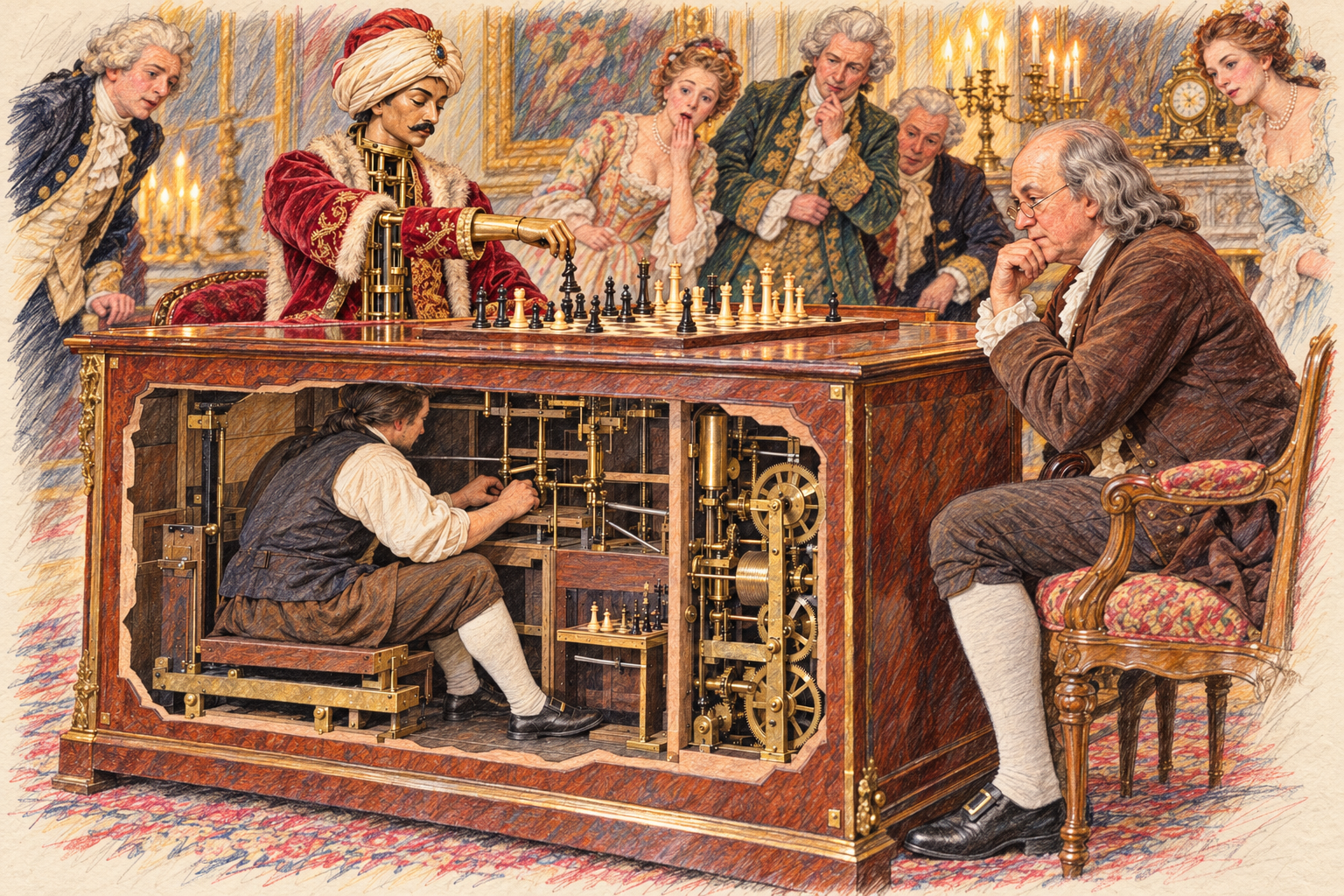
Ask participants where the work is happening before explaining the concealed player. The historical Turk relied on a person inside the cabinet. Use this as an opening question about human work, without suggesting that today’s language models hide a person answering each prompt.
Historical source: HNF museum reconstruction account.
Artwork: workshop’s supplied illustration. It is artistic, not documentary evidence of a particular encounter or a precise mechanism. The archive includes an offline copy for this trial. Artist credit and broader reuse terms are not established here.
2. Human work becomes training data
Amazon Mechanical Turk is a marketplace for human tasks. Its requester guide describes workers annotating examples for machine learning, including image labels and sentiment judgments. Ask who defines the categories and who benefits from the work.
Source: Amazon MTurk getting-started guide. This is an example of a labor marketplace, not evidence that OpenAI hired through MTurk.
3. One word at a time
Give each group a sheet with the identical prompt and response starter. Each person reads the whole visible text, adds one word, then passes the paper. A participant may write STOP when the story feels complete. Set a short time limit if no one stops. Read the completed stories aloud.
Prompt: Tell a short story about a surprising discovery at school
Response starter: At recess, we found a…
Use invented school events. Do not include student names or private student information.
4. What shaped the story?
Compare stories made from the same prompt. Ask what earlier words made the next choice feel likely and where someone changed direction. Participants bring human experience and judgment. The analogy illustrates context and sequential choices, not how weights are trained. Model tokens can be shorter than words.
5. Human feedback in InstructGPT
In the 2022 example, human demonstrations support supervised fine-tuning. Human rankings train a separate reward model. Further reinforcement learning uses that model’s scores. Labeler choices and researcher guidance influence the result. This is one historical method, not a complete description of every current system.
Source: OpenAI’s InstructGPT explanation, especially Methods and Generalizing to broader preferences.
6. Whose judgment counts?
Invite teachers to connect the examples to classroom decisions. Who chooses what a good answer looks like? Who can afford the tools? Who performs labeling and evaluation work? End with one question they would ask a provider before classroom use.
Editing and presenting
The two HTML files contain matching editable slide content. No build step, account, installation, or network connection is needed for playback. Fonts, scripts, styles, and artwork are local. Use the Print handout link for a consistent six-page printout. Speaker notes live on this page so they work from local files in both engines.
These trials intentionally use the same restrained transitions and fully visible content. They compare navigation and authoring fit rather than each engine’s entire feature set. See third-party notices for pinned versions and licenses.