14 October 2026 · Fictional story · 632 spoken words
Chloe, Bridget, the factory and the services are fictional. The later artwork is an imagined future possibility. This is a new narrative draft, not a transcript of the trial telling or a revised slide deck.
Approximately five-minute rehearsal target: 632 words at an assumed 140 words per minute, plus 35 seconds of pauses (5:06). Estimated range at 135–150 words per minute: 4:48–5:16. Not a measured live performance. Scene notes are not spoken.
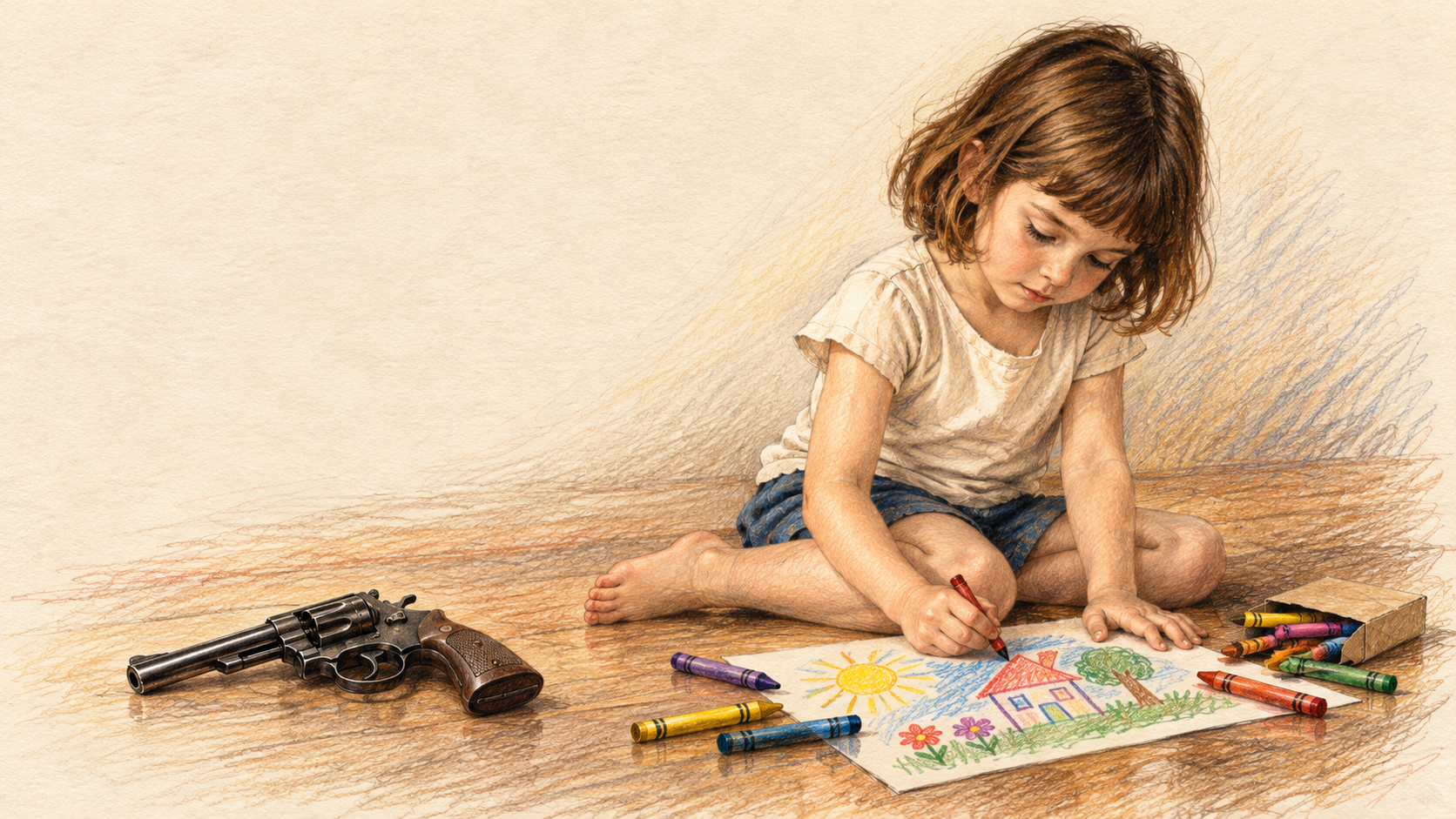
Existing opening illustration, unchanged. See scene notes for staging.
Spoken narrative
Chloe draws houses with crooked chimneys.
“Birds need somewhere to sit,” she says.
She presses so hard that the purple crayon snaps. She examines the two pieces, peels the paper off one, and rolls its side across the page. Now the house has an enormous purple evening behind it.
She grins. That wasn't the plan.
On a school trip to the crayon factory, Chloe stands on tiptoe at the rail. A worker shows them wax, color, a mold. She points to a tray of purple crayons.
“Could you make it darker?”
The worker shows her where the color goes in.
Back in class, they make their own. The teacher handles the hot wax. Chloe chooses the scraps. When hers has cooled, she rubs it across a corner of paper, frowns, and puts more blue scraps beside the mold for the next batch.
She takes both crayons home. She has plans for the second one.
At a museum, a pencil drawing stops Chloe. A tree fills the wall. She feels she could walk into its shade.
She leans closer. The shadows break into little strokes, dark where they overlap. She traces a familiar motion against her palm.
“Can we stay?”
At home, she sharpens her pencil and tries one small branch. Then another.
Years pass. Her bedroom fills with houses, including a dreadful clay one she won't let anybody throw away. On a borrowed tablet, she learns to make their windows light up. Somebody is still reading.
One afternoon, on her way home, she sees the factory windows covered with brown paper. She slows down. The little entrance where her class lined up is chained shut.
She still has the two purple crayons.
Now imagine Chloe years further on, working with AI. She sketches, asks, rejects, redraws. Together with the system, she makes a house you can walk through, though its rooms could never fit inside its walls. Rain on the roof becomes music. A visitor whistles, and a staircase curls toward the sound.
Chloe spends three evenings getting the rain right.
At the opening, a woman hums a tune her father used to whistle. The house answers, softly. She asks if she can stay a little longer. Chloe finds her a chair.
Her daughter Bridget sees it too. Later, at the kitchen table, Bridget slides her own drawing under a placemat.
“Mine doesn't do anything.”
Chloe pulls up a chair. “You should see my clay house.”
Bridget almost smiles.
“I want mine to follow me home.”
Chloe taps the drawing. “Let's try.”
She opens the little animation tool she started with. Its old address leads to the company that now runs her studio tools. The beginner version is gone. She searches for another favorite. The same sign-in page appears.
She opens her own workspace. Adding Bridget means another paid seat. Chloe reaches for her card, then reads the small print: projects on this plan can run only inside the provider's exhibition service.
Bridget points at her drawing. “But I want to take it.”
Chloe opens the help window. She tries an export. A beautiful, motionless house lands on the desktop.
“Hang on,” she says.
Bridget waits. Chloe reads the instructions again.
Then she opens her own house, the one with the rain. A notice says the version she used will stop running next month. The replacement offers to rebuild it. She looks for a way to keep the old one. The only download is a recording.
“Can you fix it?” Bridget asks.
Chloe puts her hand on the mouse, then takes it off.
“I don't know yet.”
The rain is still playing. Bridget's drawing is between them.
Before our next classroom activity, hold that picture for a moment. When the activity ends, what can the child still understand, change, and carry away?