Understanding the tools we depend on
Ideas are equal.
Opportunities are not.

Jason Kridner · Northville educators
Chloe & Bridget · fictional story
“Birds need somewhere to sit.”
A crooked chimney, a snapped purple crayon, an enormous evening.
Story frame 1 · illustration to develop
Chloe & Bridget · fictional story
“Could you make it darker?”
Factory pigment and molds; a classroom batch with more blue.
Story frame 2 · illustration to develop
Chloe & Bridget · fictional story
“Can we stay?”
A wall-sized pencil tree; strokes she recognizes; one small branch at home.
Story frame 3 · illustration to develop
Chloe & Bridget · fictional story
She still has the two purple crayons.
An ugly clay house, lit windows, then the closed factory entrance.
Story frame 4 · illustration to develop
Chloe & Bridget · fictional story
The house answers, softly.
Impossible rooms, rain becoming music, a visitor who asks to stay.
Story frame 5 · illustration to develop
Chloe & Bridget · fictional story
“Mine doesn’t do anything.”
Bridget’s drawing slips under a placemat. Chloe pulls up a chair.
Story frame 6 · illustration to develop
Chloe & Bridget · fictional story
“But I want to take it.”
Two old tools lead to one sign-in. The exported house cannot move.
Story frame 7 · illustration to develop
Chloe & Bridget · fictional story
“I don’t know yet.”
A retirement notice beside the house with the rain. Chloe’s hand leaves the mouse.
Story frame 8 · illustration to develop
Chloe & Bridget · fictional story
What can the child carry away?
Bridget’s drawing lies between them. The rain keeps playing.
Story frame 9 · illustration to develop
Understanding the tools we depend on
Understanding the mechanism
Read the logic.
Predict its behavior.
Change what it does.
Understanding the tools we depend on
Nine shuffled cards
One remembered card.
Two rounds.
Position five.
A provisional activity for rehearsal
Understanding the tools we depend on
The same short procedure
- Deal left to right, three columns.
- Name the remembered card’s column.
- Collect that column in the middle.
- Repeat the deal and collection once.
Understanding the tools we depend on
Why position five?
Any starting position
4, 5 or 6
5
Understanding the tools we depend on
A small instruction set
Rules + memory + repetition
Turing completeness concerns what can be computed.
Understanding the tools we depend on
Where is the work happening?
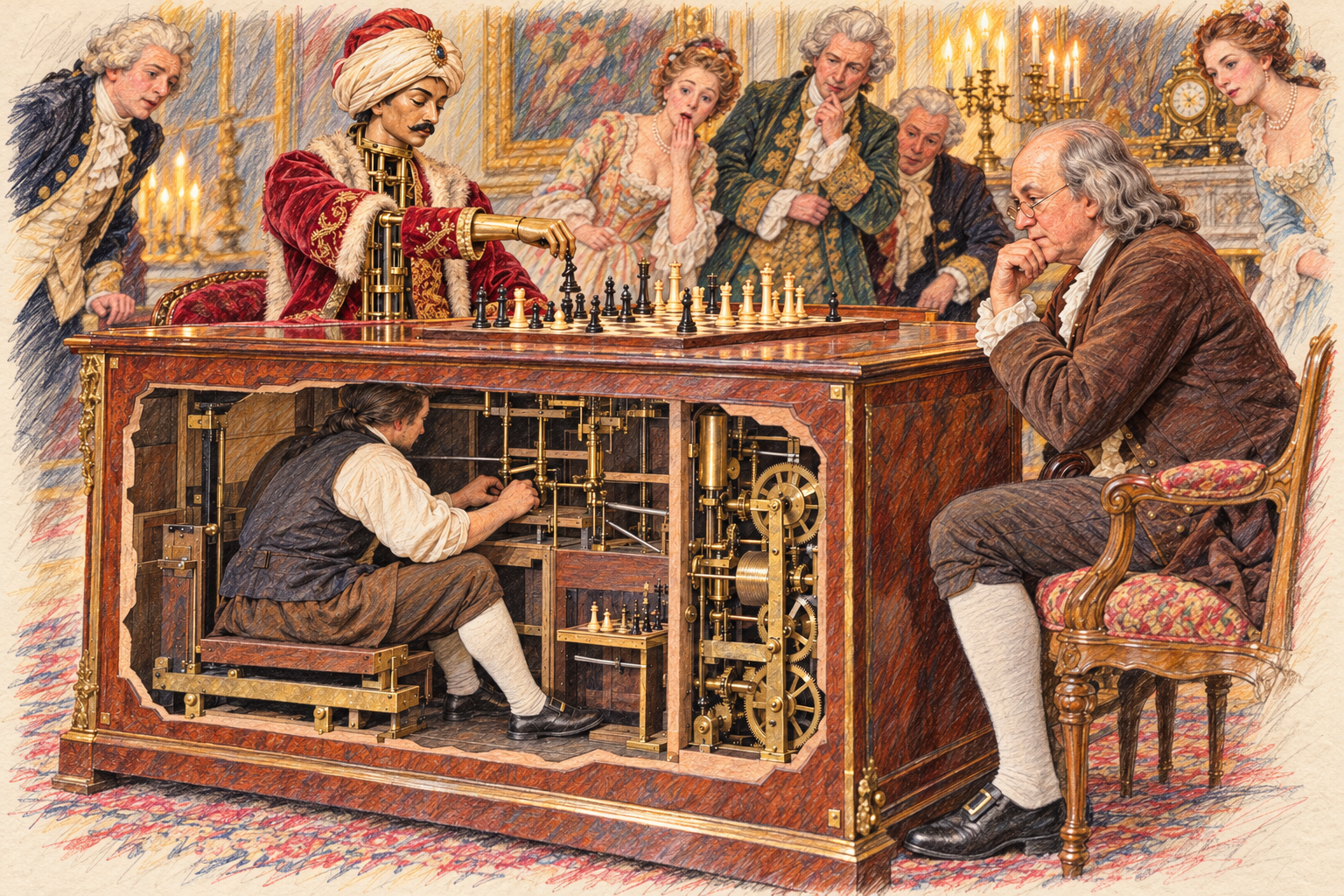
The Mechanical Turk · artistic reconstruction
Understanding the tools we depend on
People behind the examples
Someone chooses the task.
Someone judges the answer.
Understanding the tools we depend on
A word from the hat
“Tell a short story about
a surprising discovery at school.”
One next word, or STOP
Understanding the tools we depend on
Read the whole response again
Fresh suggestions.
A fresh draw.
One more word.
Understanding the tools we depend on
Same prompt. Same process.
Which word came next?
What changed after it?
Understanding the tools we depend on
Where do the probabilities come from?
Training changes parameters.
Generation uses them.
Understanding the tools we depend on
People teach and judge
Demonstrations
Comparisons
Further training
InstructGPT, 2022
Understanding the tools we depend on
Who can build the tool?
Data. Computation.
People. Infrastructure.
Using a model ≠ training its foundation
Understanding the tools we depend on
After the activity ends…
What can this child
understand, change
and carry away?